


Comprehensive Guide to Dispersing Agents
Key to Stability & Quality in Paints & Coatings
Introduction
In the production of paints, inks, coatings, and other particle-containing systems, one of the most critical challenges is achieving proper pigment and filler dispersion stability. If particles are not properly wetted, deagglomerated, and stabilized, the final product may suffer from issues such as color inconsistency, gloss reduction, sedimentation, viscosity instability, flocculation, and poor storage stability.
In this context, the role of the Dispersing Agent becomes essential. A dispersing agent is not merely a processing aid; it is a functional additive that directly influences color development, milling efficiency, viscosity control, long-term stability, and final coating performance.
This article provides a comprehensive overview of dispersing agents, including their mechanism of action, chemical classifications, formulation challenges, selection criteria, and evaluation methods used in industrial coatings and pigment systems.
1. What Is a Dispersing Agent?
A dispersing agent is a chemical additive designed to break down pigment agglomerates into fine individual particles and maintain their stable distribution within a liquid medium such as water, solvent, or resin.
In practical applications, a dispersing agent performs three key functions:
- Wetting the particle surface
- Assisting deagglomeration during grinding
- Preventing reagglomeration after dispersion
Therefore, dispersing agents play a critical role in both processing efficiency and final product quality.
Wetting vs. Dispersing
These two concepts are often confused, yet they are fundamentally different:
Wetting
Wetting refers to reducing surface tension so that the liquid phase can spread over and penetrate the solid particle surface.
Dispersing
Dispersing refers to separating particles from one another and maintaining their stable distribution to prevent re-agglomeration.
An effective dispersing agent combines both functions to create a uniform and stable pigment dispersion.
2. Why Are Dispersing Agents Important?
Proper dispersant selection can significantly improve:
- Color strength and pigment development
- Gloss and transparency
- Milling efficiency
- Storage stability
- Viscosity control
- Anti-settling performance
- Production consistency
- Processability during application
On the other hand, poor dispersant selection may lead to:
- Insufficient color development
- Flocculation
- Shade variation
- Increased milling time
- Sedimentation
- Poor gloss
- Viscosity instability
- Reduced product performance
3. Mechanisms of Particle Stabilization
The primary function of a dispersing agent is to stabilize particles after dispersion. This stabilization generally occurs through two major mechanisms.
A) Electrostatic Stabilization
In electrostatic stabilization, the dispersing agent creates similar electrical charges on the particle surfaces. Since like charges repel each other, particle collision and aggregation are minimized.
Advantages
- Effective in many water-based systems
- Economical for general-purpose formulations
- Good initial dispersion performance
Limitations
- Highly sensitive to pH changes
- Performance decreases in the presence of salts and electrolytes
- Less stable in complex formulations
Typical Applications
- Water-based paints
- Mineral slurries
- General industrial coatings
B) Steric Stabilization
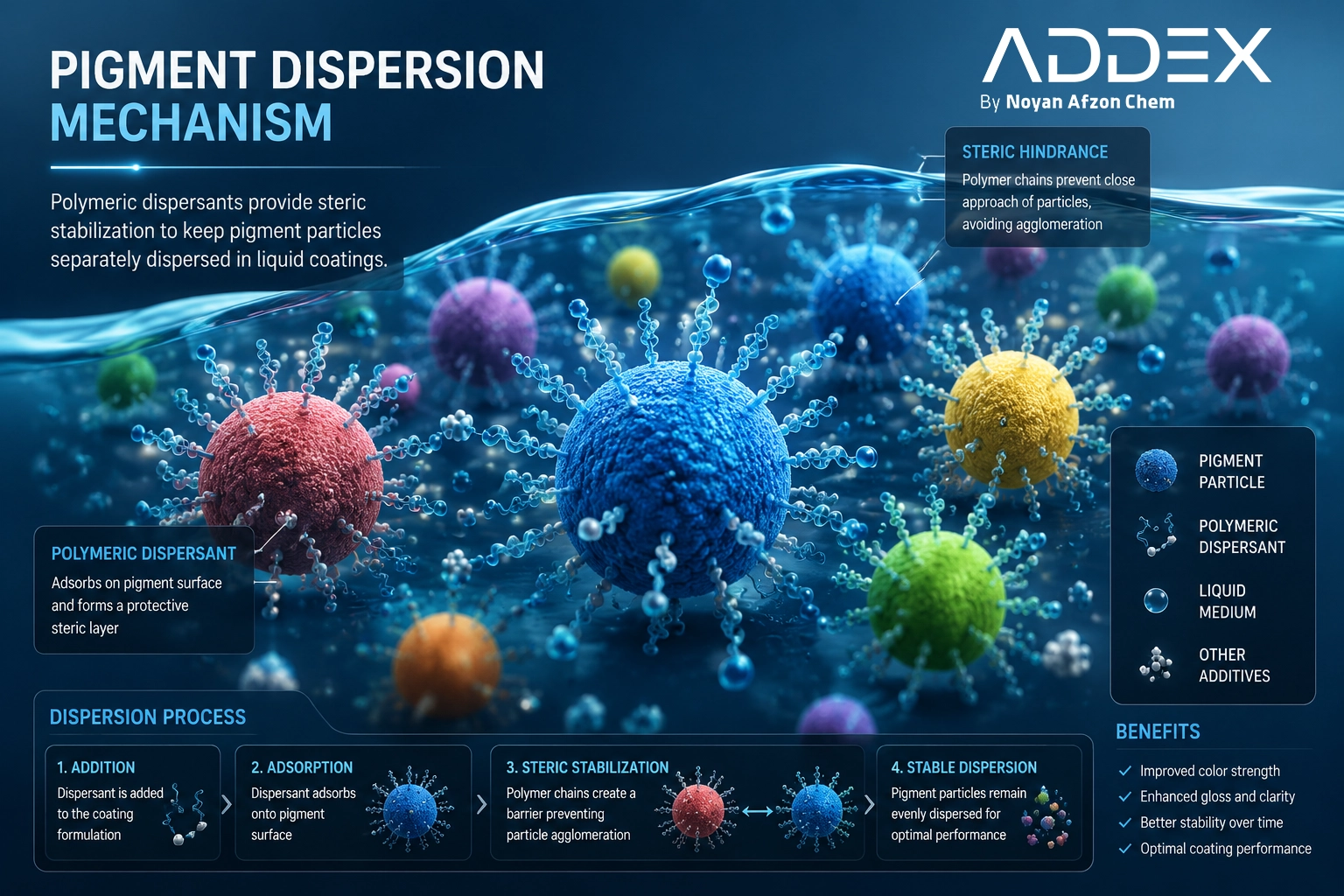
In steric stabilization, polymeric dispersants adsorb onto the pigment surface while their polymer chains extend into the surrounding medium. These chains form a physical barrier that prevents particles from approaching each other closely.
Advantages
- Excellent long-term stability
- Resistant to pH and electrolyte variations
- Superior performance with difficult pigments
- Better viscosity control
Typical Applications
- Solvent-based coatings
- Automotive coatings
- High-performance industrial paints
- Pigment concentrates
- Printing inks
C) Electrosteric Stabilization
Many modern dispersing agents combine both electrostatic and steric mechanisms. This combined stabilization provides enhanced robustness and compatibility in demanding formulations.
4. The Real Dispersion Process
Dispersion is not simply mixing powders into liquid. It involves three critical stages:
4.1 Wetting
Air trapped on the pigment surface is replaced by the liquid medium.
4.2 Deagglomeration
Mechanical energy from milling or high shear breaks pigment agglomerates into smaller particles.
4.3 Stabilization
Freshly created particle surfaces must immediately be covered by dispersant molecules to prevent reagglomeration.
5. Structure of an Effective Dispersing Agent
Most advanced polymeric dispersants contain two essential components:
Anchor Group
The anchor group has strong affinity for the pigment surface and ensures adsorption onto the particle.
Solvated Polymer Chain
This part extends into the surrounding medium and creates steric hindrance, preventing particle collision.
The balance between adsorption strength and medium compatibility determines overall dispersant performance.
6. Types of Dispersing Agents
| Type | Main Mechanism | Typical Applications | Sensitivity |
|---|---|---|---|
| Ionic | Electrostatic | Water-based coatings | High |
| Non-Ionic | Steric | Water- and solvent-based systems | Low |
| Polymeric | Strong steric/electrosteric | High-performance coatings | Very low |
7. Why Polymeric Dispersants Are Preferred
Modern high-performance coatings increasingly rely on polymeric dispersants because they offer:
- Stronger pigment adsorption
- Better long-term stability
- Improved color acceptance
- Reduced flocculation
- Better gloss development
- Enhanced compatibility with organic pigments and carbon black
These dispersants are widely used in:
- Automotive coatings
- Industrial coatings
- High-solid systems
- Coil coatings
- Pigment concentrates
- Printing inks
8. Influence of Pigment Type
Different pigments require different dispersant technologies.
Inorganic Pigments
Examples:
- Titanium dioxide
- Iron oxides
- Calcium carbonate
- Talc
- Barium sulfate
These pigments are generally easier to disperse but still require stabilization for optimal performance.
Organic Pigments
Examples:
- Phthalocyanines
- Azo pigments
- Quinacridones
- DPP pigments
Organic pigments often have higher surface area and stronger aggregation tendencies, requiring advanced polymeric dispersants.
Carbon Black
Carbon black is one of the most difficult pigments to disperse due to its extremely high surface area and aggregate structure. High-performance polymeric dispersants are typically necessary for effective stabilization.
9. Role of Dispersants in Viscosity Control
Poorly dispersed particles tend to form particle networks that increase viscosity and reduce flowability.
Proper dispersants:
- Reduce particle interaction
- Improve flow
- Enable higher pigment loading
- Optimize rheology
However, excessive dispersant dosage may cause:
- Reduced adhesion
- Foam generation
- Water resistance issues
- Surface defects
10. Common Formulation Problems
Flocculation
Flocculation refers to uncontrolled particle association that can cause:
- Color shift
- Gloss reduction
- Poor transparency
- Viscosity increase
- Reduced color strength
Sedimentation
Insufficient stabilization allows particles to settle over time, potentially forming hard sediment.
Viscosity Shock
Incompatible dispersants may interact negatively with pigments or resins, causing sudden viscosity increase.
11. Signs of Incorrect Dispersant Selection
Common indicators include:
- Poor color development
- Fast settling
- Low gloss
- Long milling time
- Excessive viscosity
- Poor tinting strength
- Seed formation
- Storage instability
- Reagglomeration after grinding
12. Step-by-Step Guide to Selecting a Dispersing Agent
Step 1: Identify the System
- Water-based
- Solvent-based
- Solvent-free
- High-solid
- UV-curable
Step 2: Identify the Pigment Type
- Organic or inorganic?
- High or low surface area?
- Easy or difficult to disperse?
Step 3: Check Resin Compatibility
The dispersant must be compatible with the resin system to avoid:
- Haze
- Phase separation
- Gloss loss
- Surface defects
Step 4: Optimize Dosage
Typical starting dosage ranges from 0.2% to 5%, depending on pigment surface area and system complexity.
Step 5: Conduct Performance Testing
Laboratory testing is essential to confirm actual performance.
13. Key Evaluation Tests
Typical dispersant evaluation methods include:
- Particle size analysis
- Grind fineness
- Viscosity measurement
- Color strength testing
- Gloss evaluation
- Storage stability testing
- Compatibility studies
- Rub-out testing
14. Water-Based vs. Solvent-Based Systems
Water-Based Systems
- More sensitive to pH and electrolytes
- Wetting is more difficult
- Electrostatic stabilization is common
Solvent-Based Systems
- Resin compatibility is critical
- Polymeric dispersants dominate
- Better suited for high-performance applications
15. Interaction with Other Additives
Dispersing agents interact with:
- Defoamers
- Wetting agents
- Rheology modifiers
- Resins
- Solvents
- pH regulators
Therefore, dispersant selection must always consider the entire formulation.
16. Common Mistakes
Frequent formulation mistakes include:
- Selecting based only on price
- Using one dispersant for all pigments
- Ignoring resin compatibility
- Incorrect dosage
- Poor addition sequence
- Lack of comparative testing
17. Best Addition Stage
Dispersing agents are typically added before pigment incorporation during millbase preparation to maximize surface adsorption efficiency.
Typical sequence:
- Resin/water/solvent
- Dispersing agent
- Wetting agent/defoamer
- Pigments and fillers
- Grinding
- Let-down stage
18. Economical Benefits of Proper Dispersant Selection
Although dispersants are used in relatively low dosages, they can significantly impact production economics by:
- Reducing milling time
- Lowering energy consumption
- Improving batch consistency
- Reducing waste
- Increasing pigment efficiency
- Improving storage stability
Conclusion
Dispersing agents are among the most critical additives in coatings and pigment systems. Proper selection directly affects dispersion stability, color development, gloss, viscosity, processability, and long-term product performance.
An optimized dispersant system helps manufacturers achieve:
- Higher quality
- Better production efficiency
- Improved stability
- Lower production costs
- More reliable product performance
For advanced formulations, high-performance polymeric dispersants are often the preferred solution for achieving superior industrial coating performance.
Commercial Solution
Selecting the right dispersing agent is not only a chemical decision but also a strategic investment in product quality, process stability, and profitability.
If you are looking for:
- Replacement solutions for imported additives
- Improved pigment stabilization
- Better viscosity control
- Enhanced color development
- Technical support for formulation optimization
the technical team at ADDEX can assist you with product selection, formulation review, and performance evaluation.
For technical consultation, sampling, and formulation support, contact ADDEX Technical Service Team.
سوالات متدوال
ADDEX-DS 1047 چیست و چه کاربردی دارد؟
ADDEX-DS 1047 یک ترکننده و دیسپرسکننده پایه حلال بر پایه پلییورتان اصلاحشده است که برای پخش پایدار رنگدانههای آلی، معدنی و کربنبلک در رنگها، پوششها، جوهرهای چاپ و خمیرهای رنگدانه استفاده میشود.
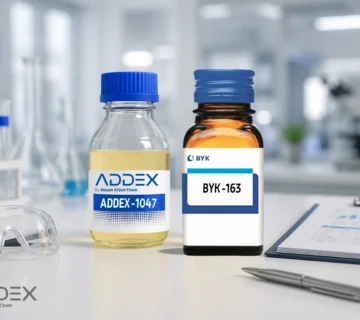
ADDEX-DS 1047 چه تفاوتی با DISPERBYK-163 دارد؟
این دو محصول از نظر کاربری در یک خانواده قرار میگیرند و هر دو برای بهبود دیسپرسیون رنگدانه، کاهش ویسکوزیته و افزایش براقیت طراحی شدهاند. طبق مقاله، تفاوت اصلی آنها در درصد ماده فعال/جامد است و ADDEX-DS 1047 میتواند در بسیاری از فرمولاسیونها به عنوان جایگزین عملکردی بررسی شود.
ADDEX-DS 1047 برای چه نوع رنگدانههایی مناسب است؟
این افزودنی برای دیسپرسیون رنگدانههای آلی، معدنی و کربنبلک مناسب است و در سیستمهای براق و فرمولاسیونهای پایه حلال عملکرد خوبی دارد.
استفاده از ADDEX-DS 1047 چه مزایایی در فرمولاسیون رنگ دارد؟
از مهمترین مزایا میتوان به کاهش ویسکوزیته آسیاب، افزایش براقیت، بهبود رنگدهی، کاهش زمان تولید، جلوگیری از فلودینگ و فلوتینگ و افزایش پایداری سیستم اشاره کرد.
ADDEX-DS 1047 برای چه صنایعی توصیه میشود؟
این محصول برای رنگهای صنعتی، رنگهای خودرویی، پوششهای ساختمانی، جوهرهای چاپ و خمیرهای رنگدانه مناسب است و بهویژه برای تولیدکنندگانی که به دنبال جایگزین داخلی برای محصولات وارداتی و کاهش هزینه تمامشده هستند، گزینهای قابل بررسی است.


بدون نظر